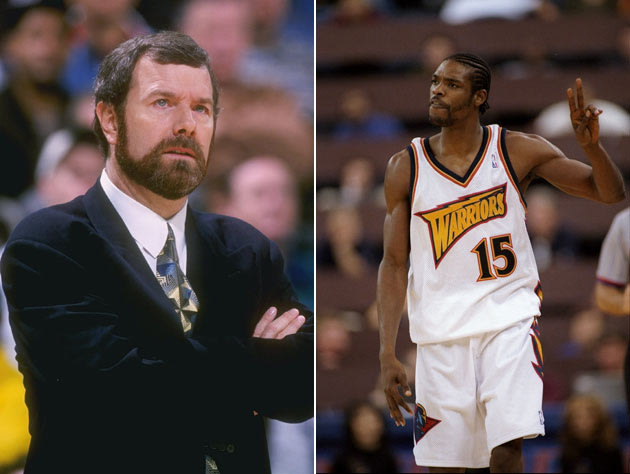
In December of 1997, Latrell Sprewell, guard for the Golden
Gate Warriors choked his coach P.J. Carlesimo. The incident occurred only
three days after Sprewell was fined for missing a team flight and showing up late
to a Salt Lake City game. Tension had been boiling between the
two, ever since Carlesimo yanked Sprewell during the Lakers game calling him a
joke three weeks earlier. Carlesimo has been known for his coaching style:
yelling and screaming at players and being hard nosed and stubborn.
Latrell Sprewell lost his cool in practice after Carlesimo got on him about
passing the ball. In which, Sprewell responded with "I don't want to
hear it today" (ESPN Classics). When Sprewell warned Carlesimo about
approaching him, Carlesimo did it anyways and Sprewell jumped at the coach's
throat for ten or fifteen seconds until other players broke it up. About
twenty minutes later Sprewell went back at Carlesimo throwing punches and
planted one on across the coach's face. The following is an analysis of
Latrell Sprewell's apology.
Sprewell
begins his apology by saying that he believes that people need to hear his side
of the story. He states,
"I
have to say that I never really got a chance to tell my side of the story.
There were times where I reached out and tried to reach out to try to rectify
the situation here at Golden State. I was willing to meet with the team and the
league after being suspended and it just seemed like no one wanted to hear what
I had to say".
Sprewell is evading the
responsibility of his actions, in order to reduce the offensiveness on
himself. In the self-defense strategies this can be classified as
Denial. This is because he doesn't even say I'm sorry but, he automatically
tries to put the blame somewhere else. Yet, he goes on to apologize by
saying that he will try to fix what he had done and stop it from happening next
time by controlling his temper.
Latrell Sprewell uses some bolstering by
talking about how he has spent so much time getting where he is today. He
states:
"I think if you look back, and I've looked back, over that
span, those 10 years, and I just feel that those 10 years of hard work shouldn't be taken away for one mistake. My career didn't
happen overnight, and I don't think it should have been taken away from me
overnight."
He also blames some of the problem on the media for
portraying him as a bad guy. You can classify this as differentiation.
He knows he did something wrong but blames the media for not showing what
really happen. He ultimately blames them for the reason why his career is going downhill. Sprewell
states:
"A lot has been in said in the media, on TV, in the paper,
about what has happened and the events that have taken place. In my opinion, a
lot of it has been one-sided, and I've really been looked upon as a negative
person, as a person that can't handle problems, and isn't good in
problem-solving situations, and that is totally not true. I've been vilified”.
As you
can see, Latrell Sprewell does not only take reasonability for his actions but
he blames the media for portraying him as a villain. And blaming his long
suspension on the NBA for not hearing his side of the story.
If you would like to see the rest of his apology: http://www.apnewsarchive.com/1997/Transcript-of-Latrell-Sprewell-s-public-statement/id-64b3ccc28ba73589a617dc1d33cffdc6

I think he makes some good points in his apology and for that situation I think he went about it right. I can't imagine being in a situation like that where only one side of the story is being told and its not yours. Not only was his career at risk but his image was too. He was right to use the strategies he did. I think his apology was appropriate for the situation.
ReplyDeleteThe self-defense strategy he used was actually Evading Responsibility. He never really said "I'm sorry," instead he said things like, "you didn't get to hear my side of the story." Maybe we didn't hear both sides, but when you do something that reprehensible you are supposed to just take it. I feel mortification would have been more accepted by fans, and who knows, maybe he would've had a longer NBA career if he'd done it differently.
ReplyDeleteI think this player took his actions a little too far. He assaulted the coach and then blamed the media for portraying him as a villain. By doing this, I do agree that he was evading responsibility. His violence called for corrective action, and when he received it he felt that it was too harsh. It seems that the NBA definitely punishes its players a little more harsh then other organizations.
ReplyDeleteThe media is powerful and he figured that out the hard way after making a huge mistake in his life. Instead of accepting he made a mistake and moving on he tried to evade the responibility and ended up being quite hated. Rough life.
ReplyDeleteI agree that would be very frustrating to only have the other side of the story that is not yours being told to the public. He was definitely evading responsibility, nowadays the media is so big and makes such a huge impact on society that you can't just blame the media for making you look bad.
ReplyDelete